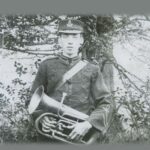
Edward George Ayden, affectionately known as Ted, was a man whose determination, compassion and commitment to others left an enduring mark on his community.
Born with a cleft palate, Ted faced significant challenges with speech and communication from an early age. Rather than allowing these obstacles to define him, he developed a remarkable resilience and an unwavering desire to serve others.
From Oral Recording with Ted Ayden 1970:
I started at Benhall Green school when I was 2 ½ years old and they wouldn’t put boys in trousers then until they were 5, so I went in petticoats. It was a great day when you got put into trousers. You started school at 9 in the morning, come out at 12 for dinner and then back in at 1, and then come out at 4 pm. If you’d been a naughty boy you had to stop in and do some sums and write some lines. There were naughty boys even in those days!

Ted Ayden 2nd from the left front. He was known as Ted, the First Aider in the village. If anyone was ill or fell over, Ted was called on to help.
From a History of the Ayden family:
Ted entered the Post Office service as a telegraph messenger and was stationed at Benhall. He cycled to Glemham Hall as many as three and four times a day besides other journeys to business premises and big houses in the locality. His wage was six shillings per week which included one shilling for keeping his cycle clean, but because of the war he graduated to postman quickly. Ted was enlisted in the Army Service Corps on the 6th June 1916, unfortunately his detailed Army records were destroyed in the WW II blitz. At one time he was selected to entertain the troops at a Christmas party in Arras in 1917, and toured the villages in the district.
In 1918 he was seriously injured during an aerial bombing attack and was returned to Britain to recover in hospital.

A rare image of Ted, the postman. Left to Right: William Nathan Nicholls, George Storey & Ted.
Although his formal education had been limited, Ted believed strongly in self-improvement. Determined to advance, he attended evening classes three times a week while working full-time, studying diligently to pass the Post Office examinations that enabled him to become a Sub-Postmaster. He then used his knowledge for the benefit of others, generously helping neighbours who could not read or write by completing official forms, writing letters and preparing greeting cards on their behalf. For many, Ted became not only a trusted public servant but also an invaluable source of practical support.
The hardships of war strengthened rather than diminished Ted’s commitment to his community. Deeply conscious of the sacrifices made by those who never returned and the emotional scars carried by those who did, he became a driving force behind the creation of a meeting place (Benhall Hut as it was known then) where ex-servicemen could gather for companionship, support and recovery. When funding for the project fell short, Ted did not simply appeal for donations—he organised and performed in theatrical productions, patiently raising the money needed to bring the vision to life.
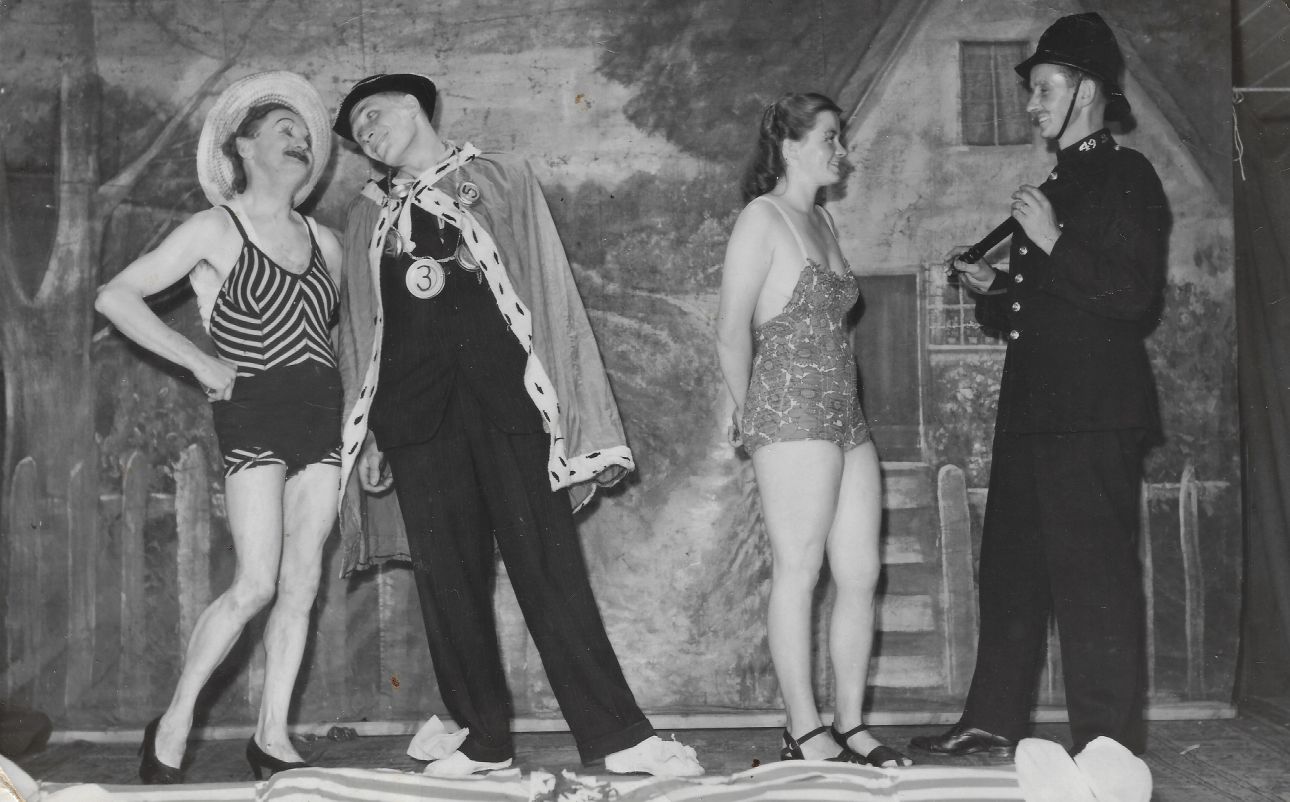
Ted Ayden in drag far left 1953

Ted Ayden performing at Harvest Festival 1963
His commitment to the community extended well beyond his professional life. A devoted advocate of the local Sunday School, Ted encouraged young people to strive for excellence by establishing the Ted Ayden Trophy, awarded annually to the most deserving scholar. His dedication to the organisation continued throughout his life, culminating in his appointment as Superintendent, where he guided and inspired future generations.

To stop here would miss out Ted the Flower Show instigator, Ted the poet, Ted the photographer, Ted the hairdresser, Ted the sport’s supporter (Bowls, Cricket and Football) and Ted the family man (see images of Ted with family below). An exhibition with images and an oral recording of Ted will be on display at the Local & Family History Open Day, Fromus Centre, Saxmundham on Saturday 12th September 2026. See under Events above for further details.
Ted Ayden was, in every sense, no ordinary man. Through quiet determination, selfless service and an unwavering belief in helping others, he transformed personal adversity into a lifetime of extraordinary contribution. His legacy is not measured simply by the roles he held, but by the countless lives he enriched and the stronger community he helped to build.