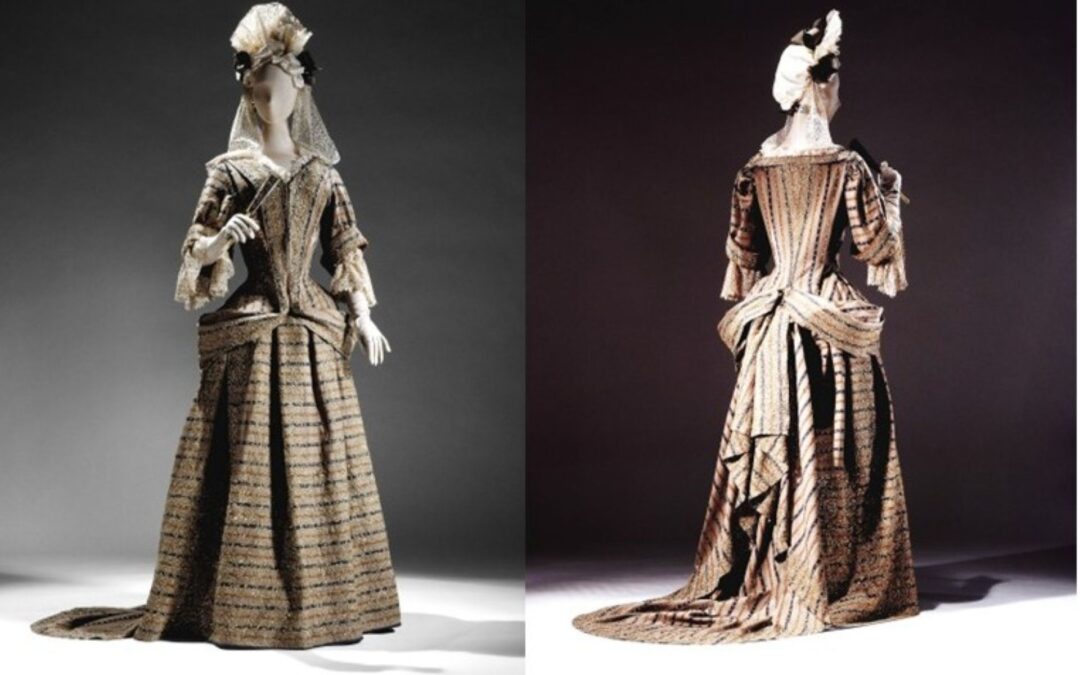
Above early mantua and matching petticoat made of striped woolen fabric and embroidered with silver-gilt yarns, English, from Kimberley Hall, Norfolk, about I690-I695.
Courtesy Metropolitan Museum of Art, CC0, via Wikimedia Commons.
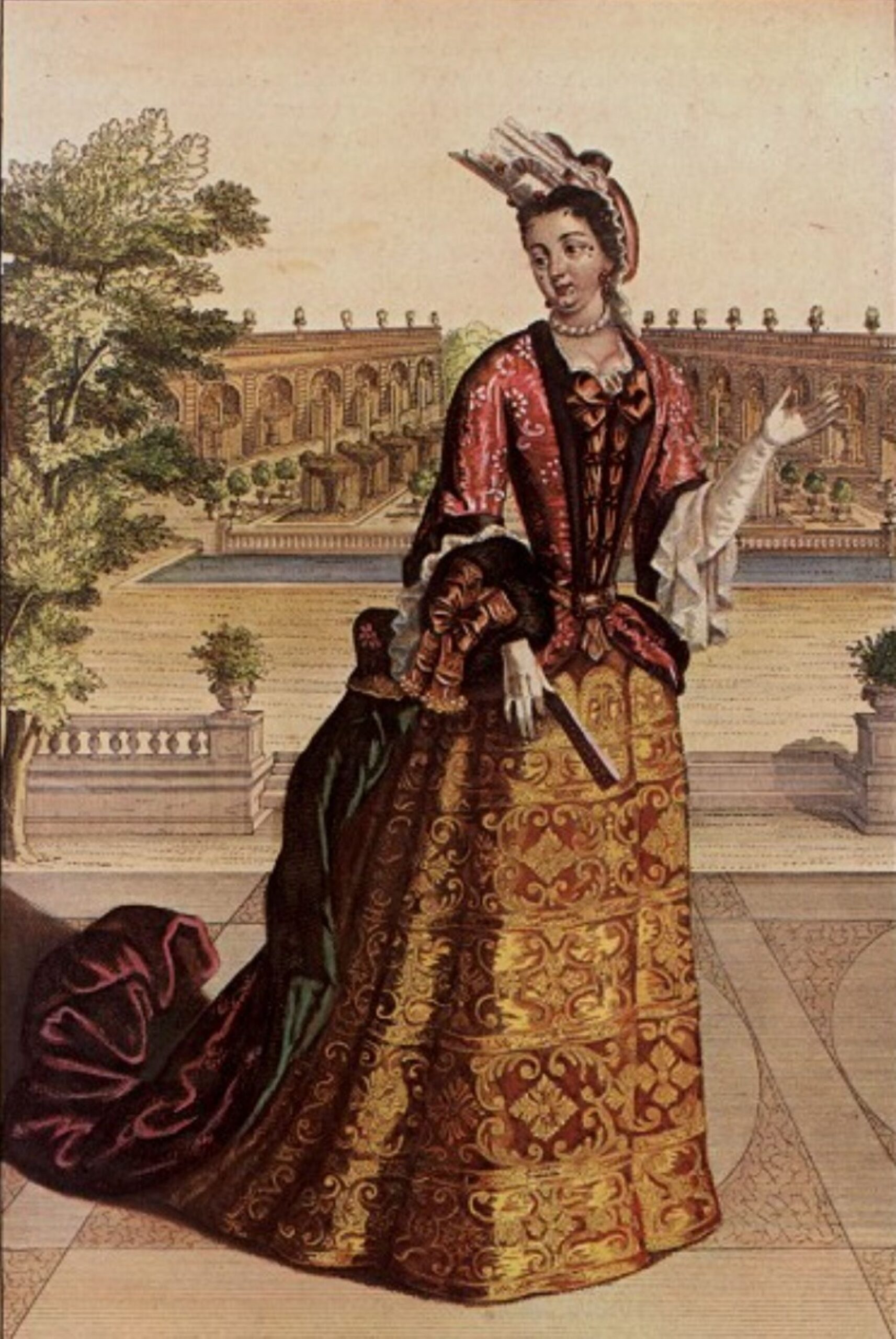
The Mantua was a 17th-18th Century gown with a draped, pleated bodice and an attached open-fronted skirt worn over a matching petticoat. It originated C1670s as an alternative to the rigid bodices being worn at the time.
The word Mantua is thought to have originated from Middle-Eastern robes which had been imported into Europe. By 1680s the mantua was the basis for all women’s gowns and was widely worn in Europe and the colonies.
It became very popular as it was less formal. It had a stomacher (a decorative triangular front panel) which attached to a bodice therefore allowing the wearer the flexibility to adjust the fit, such as when having a baby.
Though originally intended as an informal style of dress, it soon evolved into high court attire by 1750s using a hooped petticoat that created large, wide silhouettes sometimes several feet wide and therefore needing a lot of fabric! Typically, they were made with rich patterned brocade silk with silver or gold threads, thereby supporting the domestic silk industry and more elaborate than the solid, coloured satins of earlier years.
What is important to note is that up until this point all women’s and men’s clothing would have been hand-made by a Tailor, which would have been a male. The popularity of the Mantua required specialist skills which led to a rise in female garment makers. From this period women’s roles in the fashion industry were fundamentally changed, they now had a trade that gave them both an income and independence.
In Benhall, Elizabeth Mills became a ‘Master’ of mantua making and took on several apprentices, all female, for periods of 1, 2 and up to 4 years.
1757 Abigail Route
1758 Sarah Baxter
1759 Jane Read – 4 years
1762 Alathea Dawkins
1764 Elizabeth Allen
1765 Elizabeth Bishop
Then working from Kelsale:
1774 Mary Bayes
1776 Sarah Needham
1777 Letitia Osborne
Left: 1698 La Comtesse de Mailly wearing a mantua gown. Courtesy Wikipedia
The Mantua Maker from a book called The General Description of All Trades dated 1747 which was the definitive guide for parents thinking of putting their offspring into an apprenticeship in order to learn a Trade:
This trade belongs entirely to the Women, both as to the work and the wear, and a very extensive one it is, as well as in the Country as the City. It is reckoned a genteel as well as profitable employ, many of them living well and saving money.
They take girls and young women apprentices who must work early and late as business calls. To make a Mistress (master of her trade), there is little else wanting than a clever knack at cutting out and fitting.
There is of course much skill to making this style of dress as it is hand-sewn, pleated and has to be fitted in situ on the wearer. These are not ready-made garments as we have today.
By the late 18th Century this style of dress fell out of fashion.